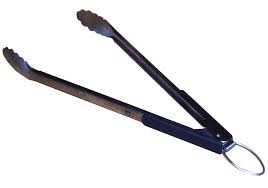
Tongues and tongs and medieval monks


The picture above made me laugh. One of those times when you think, "Hmm...spelling really does matter sometimes".


But why do we spell this:tongue but these: tongs?

Let's take tong first. We spell this as it sounds, like song, oblong, dongle.  Easy!

But tongue rhymes with hung (at least in my accent), so why the o and why the u?

To understand the o, look at some other words that use o when it sounds like u: come, some, love, monk etc. In the middle ages many written letters took the form of up and down strokes (called minims):


Can you identify these letters? (They don't make a word but they are in alphabetical order):

Quite tricky, isn't it? So if some and love were spelt as they sound they would look like this:

And if the word for the thing in your mouth was spelt tung, it would look like this:

The u and n are not so easy to read together. Compare it with :

So the monks, who were the ones who wrote in those days, replaced the u in some common words with o. It made it easier to read but more difficult to write!
Now, what about the u after the g in tongue? To find out about this I consulted my go-to etymology http://www.etymonline.com/ and read there:
website:

The spelling of the ending of the word apparently is a 14c. attempt to indicate proper pronunciation, but the result is "neither etymological nor phonetic, and is only in a very small degree historical" [OED].

So in other words, someone thought it would be easier to read the g in tongue correctly than it would be in tong or tung. We don't know why they thought this and, well, they were probably wrong (possibly right in their own accent), but we are now stuck with this spelling.

Anyway, guys, please don't touch the bread with your hands or tongues. Especially tongues!

Acknowledgements
The bread image has been circulating on social media but I couldn't find the original source I'm afraid.
The tongue image is from: https://upload.wikimedia.org/wikipedia/commons/thumb/7/7e/Face-tongue.svg/768px-Face-tongue.svg.png
The tongs image: https://upload.wikimedia.org/wikipedia/commons/1/15/Grilling-tongs.png
The monk image is from https://upload.wikimedia.org/wikipedia/commons/thumb/4/49/Medieval_writing_desk.jpg/602px-Medieval_writing_desk.jpg
The medieval writing is done with http://fontmeme.com/old-english-fonts/#none


Teaching Spelling to English Language Learners is 5 years old! I can't believe it. If you haven't got a copy yet, now's your chance, there's 40% off if you buy it from Lulu.com... but only for a few more days.

Photo from Roland Tanglao https://www.flickr.com/photos/roland/3394825139


Chip, cheap, ship, sheep - remembering the spelling

Words that sound similar, especially to learners of English, can be a nightmare to spell.

A colleague in Algeria wrote that his young students mix up the spelling of the words chip, cheap, ship and sheep. If you're a native speaker of English you might think that the only problem here is the two different ways of spelling the long e sound in cheap and sheep. Otherwise the sounds tell you how to spell them, don't they?. But if you're a learner of English as a foreign language, you may well not be able to hear or produce the two different vowel sounds in ship and sheep. And the same difficulty is common with the different consonant sounds in ship and chip. So that's where phonics falls down for learners of English.

So let me try to help.

If we can't rely on sound for spelling these words, perhaps we can find something in the meaning to help. But that's usually easier with longer words. So I had to get a bit creative with these.


Linking the meaning with a photographic image of the letter.

Using synonyms to remember those two vowels
Using the word shape linked to the meaning 

Using drawn images to remember the vowels


You'll notice that:
  • there are lots of different ways to help learners remember
  • visual images stick in most people's memories
  • linking meaning with spelling gives learners a hook to hang the spelling on
  • this is a great way to differentiate between two (or more) similar words that cause spelling problems
  • I can't draw! It's true I'm rather embarrassed about these drawings - particularly those sheep! - but in fact here I think it's an advantage because it makes them funnier and it shows people (teachers and learners) that they don't have to be artists to be able to do this. I'm most certainly not!


Teachers! Parents! People who find spelling hard! 


I invite you to try it yourselves with words your learners / your children / you can't spell or confuse. 


Start by identifying the problem part in the word. Think about the whole word shape and think about the shape of those tricky letters, but always think about the meaning too and try to make a link. Can you make a visual link between the spelling and the meaning? 


Try out some different ideas - just the thinking and drawing will help memory, so it works best if the person who is having the spelling difficulty does it himself or herself or you do it together. The images can then be displayed as a reminder if necessary - but remove the display as soon as possible so the memory needs to do a bit of work. 


Please share your images with us in my Flickr group:  https://www.flickr.com/groups/spellingimages/


And please, feel free to tell others about this Flickr group, this blog, this idea and/or my Facebook page: https://www.facebook.com/thespellingpage

Looking forward to seeing your pictures!

Johanna
 .


Learning to spell Definitely

It's definately  defnetly certainly got to be one of the most misspelt words - definitely.

By the time you've read this post, you'll definitely never misspell it again. But how DO you learn those words that refuse to be learnt.

Here's my advice:

Don't rely on sound alone. Depending on your accent, this word definitely might sound a bit like "def-nut-lee". In fact you really can't hear how that vowel between n and t is spelt, so that's not going to help you. Going on sound alone it could be a, e, i, o or u.

Try more than one way to remember. At least one of them will work for you. And if you can use more than one of those methods, you can check that you're right.

Here are some ways to remember the spelling of definitely.

1) Build it up. This is my favourite way (and how I personally learnt to spell definitely).

finite  (easy to spell)
de + finite = definite
definite + ly = definitely

_______________

2) Think about the error you usually make (people often write this word with an 'a') and kill it!

There's definitely no 'a' in definitely.

_______________

3) Look at the shape. If you follow this blog you'll know I do a lot of work with word shapes. But they don't work so well with long words and not at all with vowels. So here's another way. Look at the combination of letters below. What does the overall shape remind you of? You might need to squint!
eiie

Does it look like a car? Or an armchair? Or something else? Remember those are the vowels in this word:
definitely

_______________

4) Play a game: how many words can you find in the word definitely? The letters must be consecutive not anagrams. So fin is fine but fit isn't.

definitely

_______________

5) Relate part of the spelling to part of another word that you can spell.

I've definitely finished

_______________

6) Colour your vowels. Decide on a colour for each vowel. For example:
a - grey
e - green
i - bright red
o  - yellow
u - blue
(the names of the letters sound like the colours)
Then write the word:
definitely
Download resources for coloured vowels here.

_______________

7) Check you've got it. Use my Look Say Cover Write and Check chart to test yourself. Download it from here: or read more about it here.

_______________

Got it? Any other ways to remember? Go ahead and share them.

How to Self-Publish

Ever so slightly off-topic, this one.

My book Teaching Spelling to English Language Learners was self-published. What does that mean? How can teachers self publish? I am giving a presentation at the 49th IATEFL Conference in Manchester called The Why, What and How of Self Publishing. Here are the slides and the handout for those who attend and those who can't.

Handout 1 (for notetaking)
Handout 2 (links and references)
Slides

If you have any questions, please add them to the comments.

Johanna


"What Teachers Should Know About Spelling" article

I am grateful to Megan, an Australian follower of The Spelling Blog, for pointing me to this summary of what seems like a very interesting talk by Dr Misty Adoniou about teaching spelling. Her ideas are similar to mine in many ways but have some really interesting variations. To summarise the summary(!):

  • Phonics and visual skills are not the most important indicators of being a good speller
  • English is morpho-phonemic (based on meaning as well as sound) and etymology (word origin) plays a large part, so these two aspects should be explicitly taught across the curriculum (if taught in English, of course)
  • We need to teach 6 types of knowledge about words to spell them well: meaning, sound, acceptable and typical letter patterns, origins, parts of words and remembering what words look like.
  • We should teach spelling strategies through words that learners meet in context  in real books rather than having lists of words to learn that illustrate a strategy.

Thank you, Misty, Megan and Tina Williamson, the summary author. More about Misty Adoniou

Johanna

Winner of the International Literacy Day competition

And we have a winner! 

September 8th was International Literacy Day. To raise awareness of this I ran a competition to win a copy of my book, Teaching Spelling to English Language Learners. The winner is .... Fitta Astriyani from Indonesia. Fitta says she and her colleagues have not been able to find up-to-date books about teaching English spelling in Indonesia and her students certainly need help in this area. Fitta has a great blog herself - take a look at all the fun and creativity at http://funkreatifittaz.blogspot.co.uk/. So congratulations Fitta - your book will be with you soon!

Everyone else who entered will soon get a voucher for discount on the book. 

But let's get back to the reason for the competition - raising awareness of literacy around the world. Here are some facts:

There are about 775 million illiterate adults in the world (nearly 16% of the global population) and nearly three quarters of them are in just ten countries. By far the largest number come from India, but it does not have the highest percentage of illiterate adults. According to the CIA Factbook, the country with the lowest number of literate adults is Burkino Faso with only 21.8%. 

In Afghanistan, the rate is slightly higher (28%) but it has the lowest rate of female adult literacy: only an unbelievable 12.6% (in 2000). We know that female literacy is crucial to the development of future generations.

But it's not all bad news. Literacy rates are increasing now. According to Unesco, between 1990 and 2011, the adult literacy rate in the Arab States rose from 55% to 77% and the youth literacy rate from 74% to 90%. South and West Asia also saw very welcome improvements.


International Literacy Day 2013 - Win a free book!

It's the UNESCO International Literacy Day on Sunday 8th September 2013.

Competition!
To celebrate I am offering a free copy of Teaching Spelling to English Language Learners to the person who convinces me they deserve it most! And a discount voucher to everyone else who enters the competition following the rules below.

All you have to do is email me at johanna(dot)stirling@gmail.com
  • before midnight (GMT+1) Sunday 8th September -  not after please
  • say why you deserve a copy of Teaching Spelling to English Language Learners more than anyone else
  • The Subject of your email must be "ILD13 Competition"
The winner will get a free copy of the book (Recommended Retail Price £18.50) posted to them free of charge, wherever they are in the world. 

Remember you can't lose! Even if you don't win the book, you get the discount voucher just for bothering to enter. But it must be no later than Sunday 8th September 2013.

Global literacy - did you know?

Thankfully literacy rates worldwide are improving all the time but there are still millions of children who don't go to school or who are leaving primary school unable to read or write. Two thirds of the illiterate people in the world are female.

Literacy infographic here


Aspire, Inspire and Expire - related meanings?

I saw this on my Facebook feed:
https://fbcdn-sphotos-g-a.akamaihd.net/hphotos-ak-ash4/1044294_204622203023918_1799367311_n.jpg

A neat little quote for teachers I thought. Then I couldn't help looking at those three spire words and wondering what they had in common in terms of meaning. So off to some of my favourite etymological websites (www.etymonline.com and wordinfo.info) and here's what I found and worked out. 

The root here is spire meaning breathe or breath life into  from the Latin spirare

  • aspire - to breathe life upon something- to have hope
  • inspire - to breathe or blow into another - in other words, "influence or animate with an idea or purpose" 
  • expire - breathe out, especially for the last time (so meaning die or finish) - spelling note: ex means out of but we can't put that before the whole word spire (exspire) because x is never followed by s except across a compound word such as flaxseed)

And here are some more spire words

  • conspire - literally breathe together, but means to plot something together
  • perspire - to breathe through. The sweat meaning came later but I suppose is about a kind of breathing through the skin.
  • respire - this literally means breathe again but I really don't know why it's again. I guess just one breath isn't enough to keep you alive!
The there are all the spirit words that are also related: spirited, spiritual, etc

But, by the way, the word spire itself, meaning a tall pointed tower, comes from a completely different root. It's related to an Old Norse word meaning a slender stalk. 

Love this etymology stuff! Feel free to add your own etymological 'noticings' in the comments.
Johanna


ELTons nomination for Teaching Spelling

Fantastic news! My book Teaching Spelling to English Language Learners has been nominated for an ELTon for Innovation in Teacher Resources.

If you are an English language teacher you may know (or may not) what that means. The ELTons are awards from the British Council and well ...  this is what the British Council say ...

"The ELTons, sponsored by Cambridge ESOL, are the only international awards that recognise and celebrate innovation in English language teaching (ELT). They reward educational resources that help English language learners and teachers to achieve their goals."

I'm so happy, proud and honoured that my self-published work is up there with the big guys. Full list of nominees here.
Really tough competition! The winners will be announced at the Oscars, sorry, I mean ELTons, ceremony in London on 22 May 2013. 

Special offer - 40% (or more if you hurry) discount
To celebrate, I'm reducing the price of Teaching Spelling until 22 April 2013. Only £11.10 (+ p and p) per book. Save £8.50 on RRP. But if you buy it before the end of 31 March you get an extra 20% off with the coupon code VERNUM. Only available when you buy from Lulu.com. Spread the word - bankrupt me!

Johanna


Win a free copy of *Teaching Spelling* for World Spelling Day


British Council Award
for ELT Writing -
Special Commendation 2012

(RRP £18.50,
but available for
£12.99 here)
 It's World Spelling Day! 
(Wednesday 6th March 2013)

To celebrate I'm giving away three FREE copies of my award-winning book Teaching Spelling to English Language Learners. To win one, email me and persuade me why I should send you one. I'll be giving away a book each (including postage to anywhere in the world) to the three people who send the most persuasive answers. But hurry - entries must be received by email before midnight!


A few rules:
  • Emails to be sent to johanna.stirling@gmail.com with 'WSD' in subject line.
  • Emails must be received by 23.59 GMT on Wednesday 6th March 2013
  • Emails must say in 25 words or less why you need / deserve / want the book. Also give your name and street address (sorry, books can't be sent to PO Boxes)
  • Only one entry per person or organisation
  • The author's decision is final.
  • List of winners and their entries may be published on The Spelling Blog.
Please pass the word around ...

Good luck!

Change y to i ... or change i to y?


Sometimes I find it's useful to turn things upside down. Looking at something in this different way prevents me from just accepting it the way I've always looked at it and makes me consider it more carefully, perhaps noticing things I hadn't seen before.

I like doing this with language 'rules' too. I want to check out for myself whether they are really reliable enough to be useful. I've certainly found some that weren't.

y to i
In English spelling, we often hear, "If a word ends with y, change it to i before adding a suffix". This is generally true but there are, of course, exceptions. If there is a vowel before the y, it doesn't usually change. And there are irregular instances such as say and said.

One of my posts was about letters not found at the end of native English words. It contained a PowerPoint presentation in it called Never-Ending Letters in which I identified i as one of those letters (except of course for the pronoun I). While I was writing it I noticed that it might be a good idea to turn this so-called 'rule' about y changing to i on its head - turn it upside down in other words.


i to y?
What if we said: "Don't write i at the end of a word - change it to y? In other words we're changing i to y (at the end of a word) instead of changing y to i (in the middle of a word). In a compound word we also keep the 'rule' about no i at the end of each part. As well as this, we need to change i to y before a suffix beginning with i, to avoid a double i like we get in the (non-native) word skiing.

So we write tries, tried and trial, but we can't write tri for the first form of the verb (because native English words don't end in i) so we spell it try. And we can't write triing, because we don't have double i, so trying.

Let's look at more examples, to test it out:
We write babies, but baby (end of word), babysit (compound word) and babyish (avoiding double i).
We write happier, happiest, happiness and happily, but happy (end of word), and happyish (avoiding double i).
We write reliable, reliance, and relied, but rely (end of word) and relying (avoiding double i).
We write beautiful, beautify and beautician, but beauty (end of word).
We write said, but say (end of word) and saying (avoiding double i).

OK, it works ... but I'm trying to decide if this is a better way to look at it or not. There are pros and cons.

Pros
There are fewer (if any) exceptions. As long as we are talking about native English words, they don't finish in i (except the pronoun I).
The fact that a vowel before a y stops it changing to i becomes irrelevant. If there's already a y, we don't need to change anything.

Cons
The base forms that end with y aren't usually the problem when it comes to spelling. It's the longer forms that are usually more tricky. These usually contain i.
When we teach, we usually start with base forms and later deal with inflections and suffixes.

My conclusion
Turning this rule on its head is probably more accurate and easier to understand but would involve teaching words in an unnatural order. So I probably wouldn't use it with low level students, but at a higher level, if students were having difficulty, I might well point it out.

So has this little experiment been a waste of time? No, I don't think so, because it's always useful to question what's generally accepted as true. Another perspective is always useful.

What do you think?
I would love to hear your comments on this.

The Spelling Thief

Which words do learners most commonly misspell in Cambridge exams? According to the Cambridge Learners' Corpus, these:

Accommodation
Advertisement
Beautiful
Because
Beginning
Believe
Bicycle
Comfortable
Communicate
Convenient
Embarrassing
Especially
Received
Sincerely
Which


There lots of ways to help prevent learners losing marks from misspellings such as these in Teaching Spelling to English Language Learners, my award-winning book. 

Johanna

Ya gonna wanna sorta luv this - non-standard spelling surprise

I wanna look at some 'non-standard' spellings. I'm gonna surprise ya wiv some information about dem. I dunno about u but I thought these spellings were sorta new, from the sixties maybe. But I gotta tell ya, they've been around a long, long time. Ya might not believe me, but it must be true cos I read in it David Crystal's book, which I luv by the way, called The Story of English in 100 Words. He tells us when these words first made it into the dictionaries as 'alternative' spellings cos they were used so frequently:
  • wanna   -   1896
  • gonna    -   1913
  • ya         -   1941    
  • wiv       -   1898
  • dunno   -   1842
  • sorta     -   1790 (yes, really!)
  • gotta     -   1924
  • cos       -   1828
  • luv        -   1898
And look at this:
An S A now I mean 2 write
2 U sweet K T J 
The beginning of a poem called "An Essay to Miss Catherine Jay" by an anonymous author in 1875.
 
Great to see how the young people of today are reviving old spellings!


Johanna

British Council Award for ELT Writing - 'Teaching Spelling' awarded Special Commendation

I am delighted to tell you that my book, Teaching Spelling to English Language Learners, has just won an award. It has been given a Special Commendation in the British Council Award for ELT Writing.


The British Council Award for ELT Writing

The inaugural British Council Award for ELT Writing is a £1,000 award that recognises an outstanding contribution by an English Language Teaching author or authors, and is administered by the Society of Authors.


The judges said my book:
"confronts the apparent vagaries of the English spelling system with both diligence and charm ... ground-breaking ... makes a potentially dry topic fascinating"
and they called it
"a little gem of a book".
Nice, eh?

Below are some photos from the Society of Authors Awards Party where I received the great news:


 Receiving the award from Clare Tomalin.

There it is!
 So happy!!!

 With winners Michael Swan and Catherine Walter


My book on display with other prize winners 
(most of them fiction, not ELT)

All the prize winners .

The judges were Ingrid Freebairn, Judy Garton-Springer and Alan Maley.

Johanna

https://plus.google.com/u/0/113434236014721990067?rel=author

Audio downloads

If you've got a copy of Teaching Spelling to English Language Learners, I've got good news for you! You can now download audio mp3 files for some of the activities ... for free! Just click on the appropriate links on the Downloads page.

The dictations are read like this:
1) The full text at a slow natural pace.
2) Chunks of text repeated, with pauses for learners to write.
3) The full text at a slow natural pace for checking.

You will just hear other texts once.

They are all mp3 files, so you should be able to play them in class on a computer, mp3 player or burn them onto a disc.

How to Teach English Spelling Facebook Chat

Quick bit of news: On Friday (1st June 2012) I'm joining the British Council Teaching English team on Facebook for a chat about guess what ... teaching spelling! Here's what they say on Facebook.

This week’s TeachingEnglish online chat will be tomorrow, Friday 11.00–12.00 (CST – Madrid time zone). We‘ll be talking about that infernal subject – how to teach English spelling – and I’m very happy to announce that Johanna Stirling will be coming along to help host the chat and answer your questions.
Johanna is a real expert in the field. She’s just brought out a new book, Teaching Spellinghttp://thespellingblog.blogspot.com.es/p/book-teaching-spelling.html and maintains a lively blog on the subjecthttp://thespellingblog.blogspot.com.es/
Hope you can join us tomorrow!
Check the world clock for what time it is in your time zone – Best, Ann
http://www.timeanddate.com/worldclock/full.html


That's 10.00 if you're in the UK. Don't forget to check the time if you're somewhere else

To join us go to: https://www.facebook.com/TeachingEnglish.BritishCouncil

I've never done this before, so hope I can keep up without making too many spelling mistakes ;-)

See you there.
Johanna

Is our spelling really getting worse?

I read so many people bemoaning the fact that our spelling is getting worse. And most seem to blame technology. I'm not sure that our knowledge of spelling is getting worse and I don't think technology is solely to blame if it is.

The fact is that we write far more than we ever used to (and I think that's a good thing!). And also much of what we write is for public consumption. So of course mistakes are seen more. We are also ridiculously 'busy' with constant distractions, so the main problem seems to be that we don't take time to check what we've written. Even people who are complaining about other people's spelling let themselves down. I read this today:
 "Myself, i HATE to see spelling errors in texts that are supposed to have been proff-read."
It's spell checkers that get singled out for most of the blame. I was sent an article on the subject today that I really want to respond to. So I'm going to!

You can read the article Technology Spell Check Leaves Many Adults Unable To Spell here or just read me ranting about it below.

The article starts off by claiming:
Technology has left many Britons unable to spell words like "definitely" and "separate", a survey has found. It suggests that the UK has produced an "auto-correct generation" that relies on computer spell checks. The poll, which questioned more than 2,000 adults, found that around a third could not spell "definitely" while a similar proportion failed to pick the right spelling of "separate". And around two thirds (65%) picked a wrong spelling for "necessary" from a list that did not include the right spelling.
First objection: Lots of people couldn't spell 'definitely' and 'separate' long before computers were around. I remember only learning to spell 'definitely' when I realised it contained the word 'finite'.

Second: spell checkers and auto-correct are different things. The spell checker warns you that you might have spelled something wrong and encourages you to think about what you meant to write but auto-correct just changes it for you if you've written a string of letters that people often write meaning something else.

Third: I don't like their 'poll'. Asking people to choose the correct spelling when it is surrounded by wrong but plausible spellings is asking for trouble. You might automatically write 'necessary' correctly in a sentence, but when someone offers you the choice of the word with two 'c's or one 's', it makes you stop and think that maybe you were wrong. It plants the seed of doubt. So that's bad enough but here the list didn't even include the right spelling, so it sounds like people were tricked. By the way if you can't remember how to spell the word 'necessary', remember "It's necessary to have one coat (one 'c') and two socks (two 's's)".

The article goes on:
And many people are relying on spell checks - 18% said they use this all the time. Fewer than one in 10 (9%) said they never use a spell check.
Umm ... what's wrong with using a spell check? I use one all the time too. It's a good strategy to catch your typos and words you're not sure about. In fact, what worried me about this was that 82% don't use one all the time. Try it, folks, you'll like it.

Sure there are people who can't spell well - lots of them - and it's a problem. But is it really getting worse or just more obvious? Whichever, I offer two suggestions:

1) Let's not teach children that English is spelled as it sounds (phonics) as more than 50% of it isn't. Yes, they need to learn sound-to-letter correspondences, but they also need to learn about the origins of words and look at a range of strategies for coping with the complexity that is English spelling. (See Teaching Spelling to English Language Learners for ways to do this.)

2) We should all (myself included) train ourselves to pause and check what we've written before pressing the Send button. And again we need more focus on this at school - editing.

So what about you?

  • Do you agree with me?
  • Do you have any proof that spelling has really got worse?
  • How do you feel about spell checkers?
  • And auto-correct?
  • And phonics?


Making Sense of English Spelling

I've just started a new Facebook Page called Making Sense of English Spelling. While I will continue looking at spelling in depth here, on the Facebook Page I will post interesting links, start discussions, give news and shorter comments. Please take a look and 'Like' it if you like it!

www.facebook.com/thespellingpage


Johanna

Word endings - which letters are not at the end?

It's always easier to learn something if you know the reason for it. In the PowerPoint presentation below we see which letters are not usually found at the end of native English words and how this affects spelling.

Please feel free to use the PowerPoint as you like and share it widely. Just two rules:
  1. Please don't change anything in it (if there's anything that needs changing, please write and let me know) 
  2. Always link back to The Spelling Blog. Thank you.
The embedded version below doesn't have animations. You may think that's a good thing! But actually if you want to use the presentation for teaching it's better to have them - helps learners focus on new information better. So here's a version with simple, useful animations: http://dl.dropbox.com/u/9063559/Word%20endings.ppsx 

In the next blog post, I'm going to discuss something from the Never-Ending Letters presentation that I think is pretty revolutionary! Any idea what?

Anyway here it is. I hope it's useful. I'm really interested to hear any reactions (in the Comments below).

View more PowerPoint from jomango (that's me!)

Oh no! There was a mistake on the presentation. It's now been corrected so if you downloaded it on or before 28 March, please re-download. Sorry  - and thanks to my father for noticing!

Johanna