|
| by elginwx http://www.flickr.com/photos/92239147@N00/462868700/ |
|
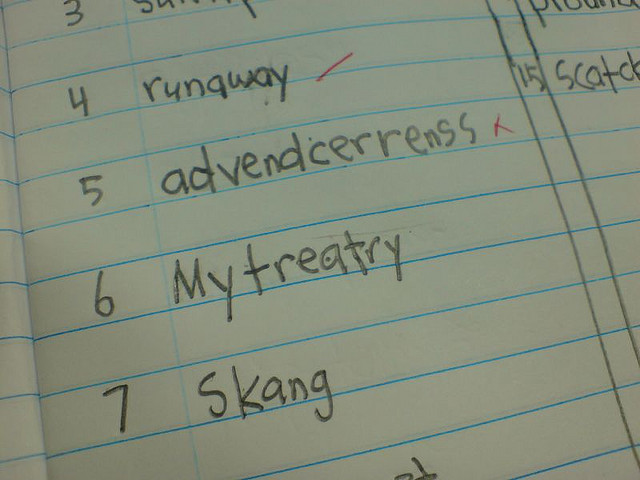
Spelling test! What do the words ‘spelling test’ mean to you? They strike fear into some people, boredom in others and smugness in those who are confident spellers. But probably the most widespread opinion is that spelling tests are a necessary evil. Are spelling tests necessary? And are spelling tests evil? Why do teachers give them? How could they be better?
Why give spelling tests?
Spelling tests (I'm talking here about the weekly type that test how well a list of words has been remembered) seem to be very commonplace in the teaching of children and sometimes with older learners too. Why do teachers give them:
- because that's what teachers have always done?
- because the institution demands it?
- because parents / sponsors want them?
- because they know spelling tests are the best way to improve their learners' spelling?
What's wrong with spelling tests?
You would hope it's for the last reason, but looking on online forums and teachers' blogs I see so many teachers saying that they
know that weekly spelling tests aren't useful. Why?
- They result in 'Friday spellers' - the many learners who do well on the tests but cannot spell the words within their subsequent writing. After the test they seem to clear their brain of those words to get ready for the next week's list.
- Some always do well, others always do badly and the ones who do badly have often spent far longer trying to memorise the words and stressing over them. The strong ones aren't being stretched and the weak ones are taking a weekly bashing.
- The learning and testing of these words takes up so much time that could be spent doing other more useful (and enjoyable) things, like reading ... or learning to really understand spelling and love words.
- Research confirms that spelling tests are largely ineffective.
So should teachers carry on giving spelling tests?
Some teachers have stopped giving the weekly spelling tests. Others carry on because they are pressurised to do so or just can't think of an alternative. Teachers who have stopped giving them say they notice no difference at all in the spelling that their learners produce in their writing.
But there does seem to be a backlash from parents and the media. I've read comments like,
"If spelling tests were good enough for us, why aren't they good enough for children now?"
And headlines like this:
"Outrage at banning spelling tests"
Most of the criticism completely misunderstands the issue. Many think that getting rid of spelling tests means getting rid of spelling instruction. No, no, no! It's
making room for instruction, which should be about helping learners to understand the systems of English spelling and learn useful strategies for dealing with spelling that they don't know.
Suggestions
If teachers must give spelling tests, here are some suggestions for making them more effective:
- Be sure of your aim and how you will use the results;
- Make sure the words are related in some way (topic, spelling pattern, lexically, etc);
- Introduce them within texts or use words that have arisen from classwork;
- Include words from previous tests. Warn learners that you will do this but do not tell them in advance which ‘old’ words will be tested;
- Give surprise mini-tests on words from previous weeks so learners know that they can't afford to forget the ones they have learned.
- Consider letting learners choose the words they are tested on from the ones given (they each choose, say, three words and these are all added together for the test);
- Test strategies as well as knowledge;
- Teach learners strategies for learning words and let them share the ones they use (for example my free, deluxe Look Say Cover Write and Check template);
- During the test give words in sentences. They write the whole sentence. Alternatively, with a stronger group, say the word and they have to write the word in a sentence themselves. To make it more challenging, give them a topic for the sentence so they can’t just learn a complete sentence by heart;
- Avoid tests which deliberately present learners with wrong spellings (they might stick better than the real spelling!);
- Learners who struggle are not expected to get 100%, but they are expected to do at least as well as they did on the previous test, aiming for some improvement. If possible, differentiate the test, so that it’s easier for weaker learners and more challenging for stronger ones. Words could have some given letters for weaker students;
- Encourage learners to keep progress charts of their spelling scores (there'll be one in my forthcoming book, Teaching Spelling to English Language Learners).